
Monitoring fluid balance is very important in the context of kidney diseases. In this article, we’ll review why it’s critical to measure relevant physiological factors related to fluid status and how InBody’s technology may support clinical settings in managing vulnerable patient populations.
Importance of Fluid Balance in Kidney Disease
According to a 2022 systematic review by Kovesdy et al, CKD also impacts more than 800 million people (+10% of the global population). Chronic kidney disease (CKD) is associated with a loss of kidney functioning that can have many serious health consequences. It has been linked to co-morbidities such as diabetes, heart disease, obesity, and increased mortality rates.
One of the main functions of the kidneys is to regulate fluid levels within the body. The total body water (TBW) of the human body comprises approximately 55-65% of one’s overall weight. TBW can be divided into extracellular (ECW) and intracellular water (ICW) components.
The InBody Body Water Analyzer offers a highly detailed analysis of fluid status. Using bio-electrical impedance, this portable device can measure each of these body water composition components.
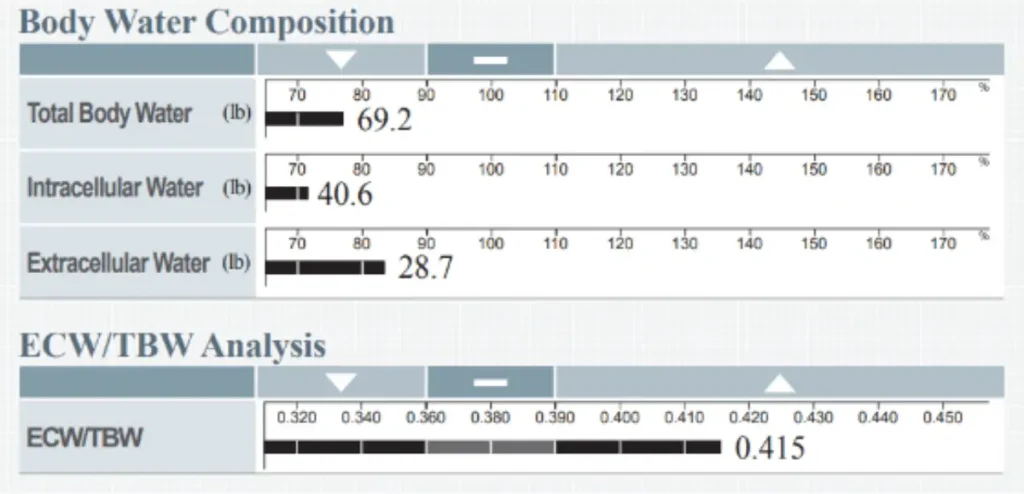
InBody BWA 2.0 Results Sheet: Body Water Composition & ECW/TBW Ratio Analysis
In many renal diseases like CKD, a decrease in kidney functioning may increase water retention, which is also known as edema. Nishimura et al (2022) conducted a study on patients who received a kidney transplant found a significant association with high measures of edema and the incidence of cardiovascular disease.
“A high edema index is associated with the incidence of cardiovascular disease. Overhydration should be especially avoided in recipients with these factors, and their fluid volume should be carefully managed” (4).

The ratio of ECW:TBW may also assist with detecting fluid abnormalities. Son et al assessed the ratios of fluid status, skeletal muscle mass, and hypotensive risk in patients receiving hemodialysis. “Patients with a low ratio of skeletal muscle mass to dry body weight (SMM/WT) had a higher rate of intradialytic hypotension”.

InBody BWA 2.0 water control calculator
The InBody Body Water Analyzer can also assess ECW and relevant ratios for each segment of the body. This may be especially useful to detect circulation issues in patient populations with kidney disease. A 2018 study by Kim et al illustrated that greater differences in arm fluid volumes were significantly associated with higher rates of vascular access failure in patients on hemodialysis and “…segmental BIA may be used as a tool that can predict vascular access failure…”
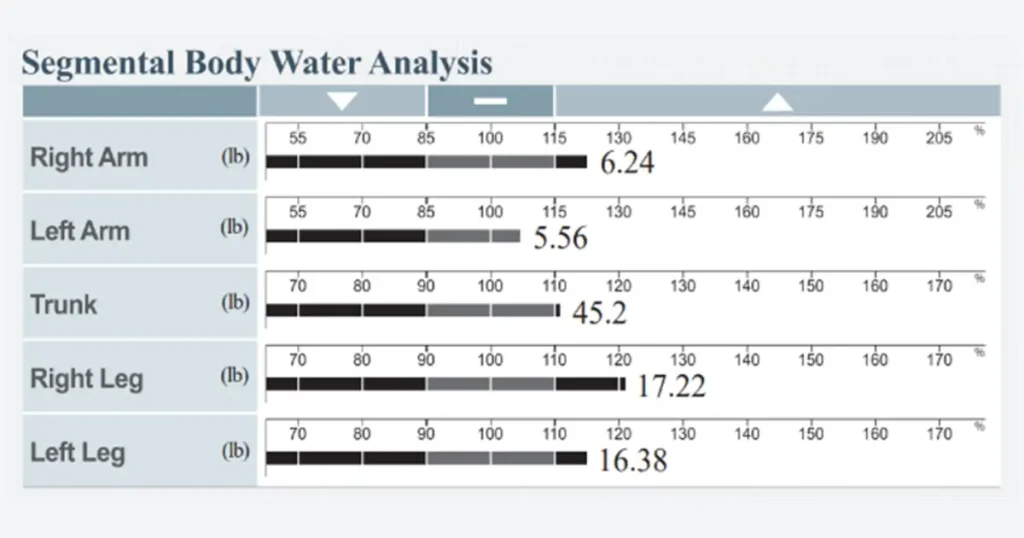
InBody BWA 2.0 Results Sheet: Segmental Body Water Analysis
References
- Kovesdy, C. P. (2022). Epidemiology of chronic kidney disease: an update 2022. Kidney International Supplements, 12(1), 7-11. https://doi.org/10.1016/j.kisu.2021.11.003
- Finco, D. R. (1997). Kidney function. Clinical Biochemistry of Domestic Animals (pp. 441-484). Academic Press. https://doi.org/10.1016/B978-012396305-5/50018-X
- Bobkova, I., Chebotareva, N., Kozlovskaya, L., & Shilov, E. (2016). Edema in renal diseases–current view on pathogenesis. Nephrology@ Point of Care, 2(1), pocj-5000204. https://doi.org/10.5301/pocj.5000204
- Nishimura, N., Hori, S., Tomizawa, M., Yoneda, T., Nakai, Y., Miyake, M., … & Fujimoto, K. (2022). Relevance of the perioperative edema index measured by bioelectrical impedance analysis for prediction of cardiovascular disease in living‐donor kidney transplantation. International Journal of Urology, 29(4), 309-316. https://doi.org/10.1111/iju.14772
- Son, H. E., Ryu, J. Y., Lee, K., Choi, Y. I., Kim, M. S., Park, I., … & Jeong, J. C. (2022). The importance of muscle mass in predicting intradialytic hypotension in patients undergoing maintenance hemodialysis. Kidney Research and Clinical Practice, 41(5), 611. https://10.23876/j.krcp.21.153
- Gallo, N., Horvath, K., Czuppon, K., Tomsits, E., Felegyhazi, E., & Kovacs, G. T. (2021). Different nutritional screening tools and recommended screening algorithm for pediatric oncology patients. Clinical nutrition, 40(6), 3836-3841.


