
Cardiometabolic Health typically involves assessing several clinical parameters for chronic disease risk—such as body mass index, waist circumference, fasting blood glucose levels, cholesterol levels, and blood pressure. However, precisely quantifying body composition beyond BMI is increasingly important in monitoring health status. In this month’s newsletter, Clinical Research Associate Joe Bonner will review why more accurate body composition parameters are beneficial to preserving cardiometabolic health status.
What is Cardiometabolic Health?
Cardiometabolic health refers to the status of your cardiovascular and metabolic system and how certain risk factors may be related to chronic disease risk. Metabolic syndrome (MS) is often mentioned when assessing cardiometabolic health, which is a condition that can increase your risk of cardiovascular disease, diabetes, stroke, and related diseases. MS is typically defined as having at least 3 of the 5 following criteria:
- Excess abdominal weight: A waist circumference of more than 40 inches in males and 35 inches in females
- Hypertriglyceridemia: Triglyceride levels that are 150 milligrams per deciliter of blood (mg/dL) or greater.
- Low levels of HDL cholesterol: HDL cholesterol of less than 40 mg/dL in males or less than 50 mg/dL in females.
- Elevated blood sugar levels: Fasting blood sugar levels of 100 mg/dL or greater. If it’s 100 to 125 mg/dL, you have prediabetes. If it’s over 125 mg/dL, you likely have Type 2 diabetes.
- High blood pressure: Blood pressure values of systolic 130 mmHg or higher (the top number) and/or diastolic 85 mmHg or higher (the bottom number).
According to a 20+ year study from United States National Health and Nutrition Examination Survey, Hearn et al (2022) reported “Between 1999 and 2000 and 2017 and 2018, U.S. cardiometabolic health has been poor and worsening, with only 6.8% of adults having optimal cardiometabolic health.”
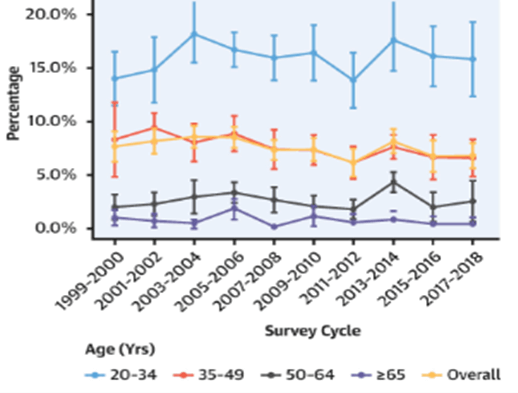
Source: RidleSource: Hearn et al (2022). Journal of American College of Cardiology.y (2005); Zijdeman et al. (2015); HMD (2024); UN WPP (2024)
Limitations of Traditional Measurements
Anthropometric measurements, such as waist circumference and BMI, have been commonly used as significant risk factors in quantifying metabolic syndrome risk. However, these body composition measures lack the ability to independently evaluate body fat, visceral fat, skeletal muscle mass, and other distinct components separately. This also has been shown to impact the classification of metabolic health. An analysis of cardiometabolic risk by BMI according to the NHANES 2005-2012 Survey by Tomiyama et al (2016) determined that “a large proportion of US adults are misclassified as cardiometabolically unhealthy according to BMI categories, indicating that the Equal Employment Opportunity Coalition and other entities should not rely on BMI when formulating health policy.” More recently, Tu et al (2025) analyzed a cross-sectional sample of the NHANES 2017-2023 Survey, noting that “metabolically unhealthy status correlates with high CVD risk among overweight and obese individuals, but not in normal weight individuals” It’s important to note that BMI was the primary way that this study determined the prevalence of individuals with obesity. Excess adiposity and visceral fat have been associated with the pathophysiology of cardiometabolic syndrome risk. However, one of the most recent clinical updates on the definition and diagnostic criteria of clinical obesity by Rubino et al (2025) highlighted that “The clinical phenotype of obesity is still uniquely defined by BMI, which provides no information about health at the individual level.”
A recent invited commentary by Dr. Katherine Flegal on BMI in the context of defining obesity highlighted its limitations further, “One limitation for defining obesity is the lack of quantitative definitions of adiposity or of BMI as a measure of fatness.” As noted in this article, BMI does not specifically measure adiposity, and there can be instances of individuals with a BMI considered to be in a healthy range still demonstrating other characteristics of obesity. In a large-scale global study by Ahmed et al (2025), global prevalence of normal weight obesity was 21.7% in a cross-sectional cohort of 471,228 participants across 91 countries. As noted in a review on the advantages and limitations of BMI by Wu et al (2024), stating that BMI’s “…limitations necessitate the embracing of emerging technologies and adopting a multifaceted approach to body composition assessment to better address the diverse needs of populations worldwide.”
Precise Estimations of Body Composition in Metabolic Health
Body composition measurements that can estimate body fat distribution and fat free mass offer precision and clinical utility for metabolic health risk. Kim et al (2021) evaluated 13,620 participants for MS risk and observed that “obesity, visceral adiposity, and sarcopenia showed additive effects on MS prediction.” As previously mentioned, waist circumference is typically incorporated into assessing abdominal adiposity for MS risk. Using waist circumference together with specific body composition elements can offer additional insight. Kwon et al (2021) conducted a cross-sectional study with 499,648 subjects, observing that the combination of “low relative lean body mass and elevated waist circumference are associated with metabolic abnormality.” Similar findings have been noted in pediatrics by Choi et al (2025), where they developed predictive machine learning models for MS in pediatrics with bio-electrical impedance (BIA) body composition measurements and anthropometrics: “The combined model exhibited superior predictive performance compared to the individual anthropometric and BIA models alone.”
These studies, and many others, emphasize the value of utilizing multiple components of body composition to more accurately evaluate cardiometabolic health than traditional methods. As we continue to advance technologies for clinical care, body composition is a critical component of metabolic health and chronic disease risk.
For more information on metabolic health, body composition, and related topics, subscribe to our newsletter and connect with our medical & research team today.
References
- Robert H. Shmerling, M. (2022, August 18). How good is your cardiometabolic health – and what is that, anyway?. Harvard Health. https://www.health.harvard.edu/blog/how-good-is-your-cardiometabolic-health-and-what-is-that-anyway-202208182803
- Metabolic syndrome. Cleveland Clinic. (2025, September 4). https://my.clevelandclinic.org/health/diseases/10783-metabolic-syndrome
- O’Hearn, M, Lauren, B, Wong, J. et al. Trends and Disparities in Cardiometabolic Health Among U.S. Adults, 1999-2018. JACC. 2022 Jul, 80 (2) 138–151.
https://doi.org/10.1016/j.jacc.2022.04.046
- Lemieux, I., & Després, J. P. (2020). Metabolic syndrome: past, present and future. Nutrients, 12(11), 3501. https://doi.org/10.3390/nu12113501
- Tomiyama, A., Hunger, J., Nguyen-Cuu, J. et al. Misclassification of cardiometabolic health when using body mass index categories in NHANES 2005–2012. Int J Obes 40, 883–886 (2016). https://doi.org/10.1038/ijo.2016.17
- Tu, D., Li, P. & Li, K. Metabolic health and cardiovascular disease across BMI categories: NHANES findings. J Health Popul Nutr 44, 273 (2025). https://doi.org/10.1186/s41043-025-01003-0
- Bovolini, A., Garcia, J., Andrade, M. A., & Duarte, J. A. (2021). Metabolic syndrome pathophysiology and predisposing factors. International journal of sports medicine, 42(03), 199-214. https://doi.org/10.1055/a-1263-0898
- Rubino, F., Cummings, D. E., Eckel, R. H., Cohen, R. V., Wilding, J. P., Brown, W. A., … & Mingrone, G. (2025). Definition and diagnostic criteria of clinical obesity. The Lancet Diabetes & Endocrinology, 13(3), 221-262.
- Flegal, K. (n.d.-c). Redefining obesity—too much is never enough | diabetes and endocrinology | jama network open | jama network.
https://jamanetwork.com/journals/jamanetworkopen/fullarticle/2840142
- Ahmed KY, Aychiluhm SB, Thapa S, et al. Cardiometabolic Outcomes Among Adults With Abdominal Obesity and Normal Body Mass Index. JAMA Netw Open. 2025;8(10):e2537942. doi:10.1001/jamanetworkopen.2025.37942
- Wu, Y., Li, D., & Vermund, S. H. (2024). Advantages and limitations of the body mass index (BMI) to assess adult obesity. International journal of Environmental Research and public health, 21(6), 757.
- Kim, S. H., Kang, H. W., Jeong, J. B., Lee, D. S., Ahn, D. W., Kim, J. W., … & Park, S. J. (2021). Association of obesity, visceral adiposity, and sarcopenia with an increased risk of metabolic syndrome: A retrospective study. PLoS One, 16(8). https://doi.org/10.1371/journal.pone.0256083
- Kwon, E., Nah, E. H., Kim, S., & Cho, S. (2021). Relative lean body mass and waist circumference for the identification of metabolic syndrome in the korean general population. International Journal of Environmental Research and Public Health, 18(24), 13186. https://doi.org/10.3390/ijerph182413186
- Choi, Y., Lee, K., Seol, E.G. et al. Development and validation of a machine learning model for predicting pediatric metabolic syndrome using anthropometric and bioelectrical impedance parameters. Int J Obes 49, 1159–1165 (2025). https://doi.org/10.1038/s41366-025-01761-1


