
Benefits of Exercise & Physical Activity Participation
Exercise offers a multitude of health benefits, “… including better general and health-related quality of life, better functional capacity and better mood states.” Many health promoting organizations promote regular engagement in physical activity. The American College of Sports Medicine and Center for Disease Control (CDC) recommend that adults engage in at least 150 minutes of moderate physical activity each week (i.e. 30 mins for 5 days a week) or 75 minutes of vigorous activity.
Unfortunately, a significant portion of the population in many countries do not adequately meet physical activity guidelines. The CDC also reported that “In 2020, 24.2% of adults aged 18 and over met the 2018 Physical Activity Guidelines for Americans…”
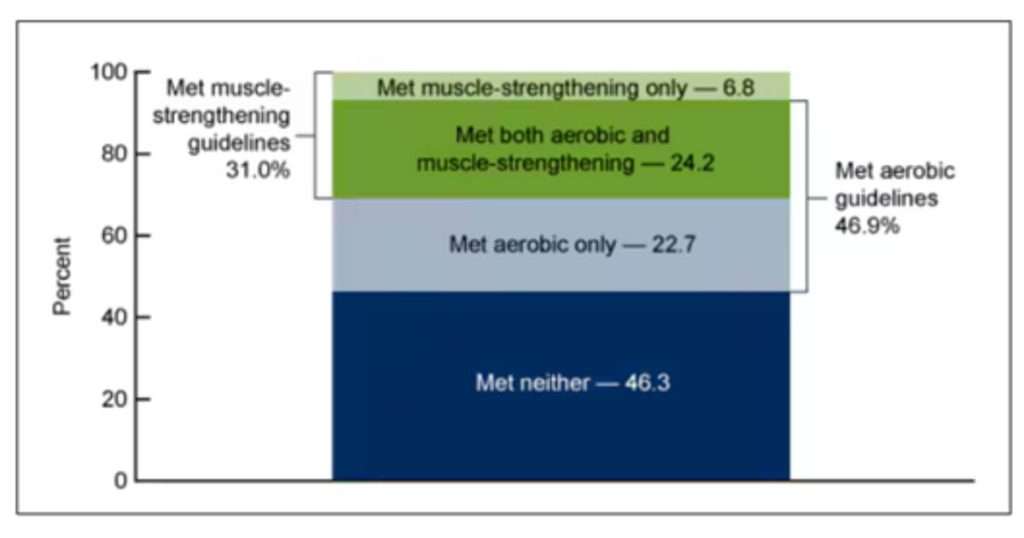
Percent distribution of adults aged 18 and over who met 2018 Physical Activity Guidelines for Americans for aerobic and muscle-strengthening activities: United States, 2020
Body Composition in Exercise Prescription
Body Fat mass
Assessing and monitoring components of body composition can support exercise prescription initiatives that aim to increase physical activity. Choi et al (2023) conducted a 12-week weight loss exercise program intervention reporting improvements in “… maintaining and lowering blood pressure and improving vascular and autonomic nervous system function.”
Skeletal Muscle Mass
A multifrequency bioelectrical impedance analysis (MF-BIA) device was used in a 10-week resistance training program by Shoenfeld et al (2020), which showed “… that MF-BIA is an acceptable alternative for tracking changes in fat mass and fat free mass during a combined diet and exercise program in young, athletic men…”
This also coincides with Hurt et al (2020), who found that, “Fat free mass and percent body fat measured by multifrequency-bioelectrical impedance had good agreement with Dual-Energy X-ray Absorptiometry across all BMI categories measured in the current study of ambulatory participants.”
Associations with Chronic Disease
Having higher levels of https://link.springer.com/article/10.1007/s10522-015-9631-7skeletal muscle mass has been associated with healthier ageing and reduced risk for many chronic diseases—such as sarcopenia, certain cancers, and cardiovascular disease. In a recent review on the importance of skeletal muscle for aging, Agostini et al (2023) noted, “Low levels of physical activity are among the main risk factors for sarcopenia…This is important from a clinical standpoint, as it leads to reduced strength and exercise capacity, both of which are required to undertake normal daily living activities.”
Exercise prescriptions should be individualized and appropriately tailored to certain populations. Body composition measures can offer a more detailed insight into how engagement in exercise may be impactful beyond BMI, body weight, or other limited measures. For example, a systematic review by Martins et al (2022) provided evidence that the phase angle (PhA), which has been related to cell membrane health, “…is directly associated with muscle strength and aerobic fitness in different age groups (children, adolescents, adults, and older adults) and in people with different health conditions (human immunodeficiency virus, Crohn’s disease, chronic obstructive pulmonary disease, bariatric surgery, kidney transplant, cancer, hemodialysis, and sarcopenia).”
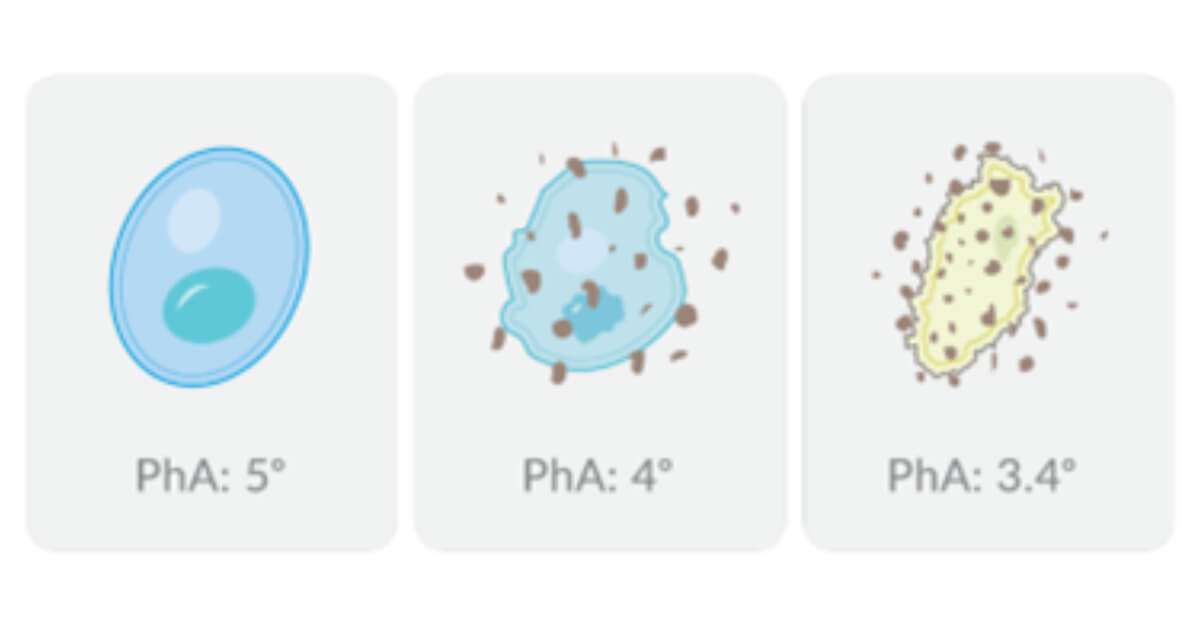
Phase Angle: Indicator of Cell Membrane Health
For more information on exercise prescription and related topics, subscribe to our newsletter and connect with our medical & research team today!
References
- Ruegsegger, G. N., & Booth, F. W. (2018). Health benefits of exercise. Cold Spring Harbor perspectives in medicine, 8(7), a029694.
- Centers for Disease Control and Prevention. (2024, October 25). FASTSTATS – leading causes of death. Centers for Disease Control and Prevention. https://www.cdc.gov/nchs/fastats/leading-causes-of-death.htm
- Physical activity guidelines. ACSM_CMS. (n.d.). https://www.acsm.org/education-resources/trending-topics-resources/physical-activity-guidelines
- Centers for Disease Control and Prevention. (2022, August 30). Products – data briefs – number 443 – august 2022. Centers for Disease Control and Prevention. https://www.cdc.gov/nchs/products/databriefs/db443.htm
- Choi, J. H., Kim, S. W., Seo, J., Sun, Y., Jung, W. S., Park, H. Y., … & Lim, K. (2023). Effects of a mobile-health exercise intervention on body composition, vascular function, and autonomic nervous system function in obese women: a randomized controlled trial. Journal of Multidisciplinary Healthcare, 1601-1615.
- Schoenfeld, B. J., Nickerson, B. S., Wilborn, C. D., Urbina, S. L., Hayward, S. B., Krieger, J., … & Tinsley, G. M. (2020). Comparison of multifrequency bioelectrical impedance vs. dual-energy X-ray absorptiometry for assessing body composition changes after participation in a 10-week resistance training program. The Journal of Strength & Conditioning Research, 34(3), 678-688.
- Hurt, R. T., Ebbert, J. O., Croghan, I., Nanda, S., Schroeder, D. R., Teigen, L. M., … & Mundi, M. S. (2021). The comparison of segmental multifrequency bioelectrical impedance analysis and dual‐energy X‐ray absorptiometry for estimating fat free mass and percentage body fat in an ambulatory population. Journal of Parenteral and Enteral Nutrition, 45(6), 1231-1238.
- Martins, P. C., de Lima, T. R., Silva, A. M., & Silva, D. A. S. (2022). Association of phase angle with muscle strength and aerobic fitness in different populations: A systematic review. Nutrition, 93, 111489.
- Agostini, D., Gervasi, M., Ferrini, F., Bartolacci, A., Stranieri, A., Piccoli, G., … & Donati Zeppa, S. (2023). An integrated approach to skeletal muscle health in aging. Nutrients, 15(8), 1802.
- Keller, K. (2019). Sarcopenia. Wiener Medizinische Wochenschrift, 169(7), 157-172.
- Penna, F., Ballarò, R., Beltrà, M., De Lucia, S., García Castillo, L., & Costelli, P. (2019). The skeletal muscle as an active player against cancer cachexia. Frontiers in physiology, 10, 41.
- Adams, V., Reich, B., Uhlemann, M., & Niebauer, J. (2017). Molecular effects of exercise training in patients with cardiovascular disease: focus on skeletal muscle, endothelium, and myocardium. American Journal of Physiology-Heart and Circulatory Physiology, 313(1), H72-H88.


