
Welcome to the InBody BWA newsletter, where we aim to provide you with the latest research & applications of body composition in clinical populations. In this edition, we will share recent studies on assessing fall risk in vulnerable populations.
The World Health Organization has recently reported that falls are the second leading cause of injury deaths globally. Over 684,000 individuals die from falls globally, with older adults suffering from the greatest number of falls (World Health Organization, 2021). In addition to older populations, children are also a high-risk group. Other risk factors of falling include hazardous working conditions, underlying medical conditions (i.e. neurological), and poor balance capabilities.
Older Adults: The Most Vulnerable Group for Fall Risk
Older adult populations are increasing at a significant rate–in part due to advancements in modern medicine, longer life spans, and lifestyle modifications (Kyriazis, 2020). Over the next several decades, the United Nations Divisions Project and World Health Organization predict that the current population of people over the age of 60 (approximately 1 billion globally) could double to 2 billion by 2050.
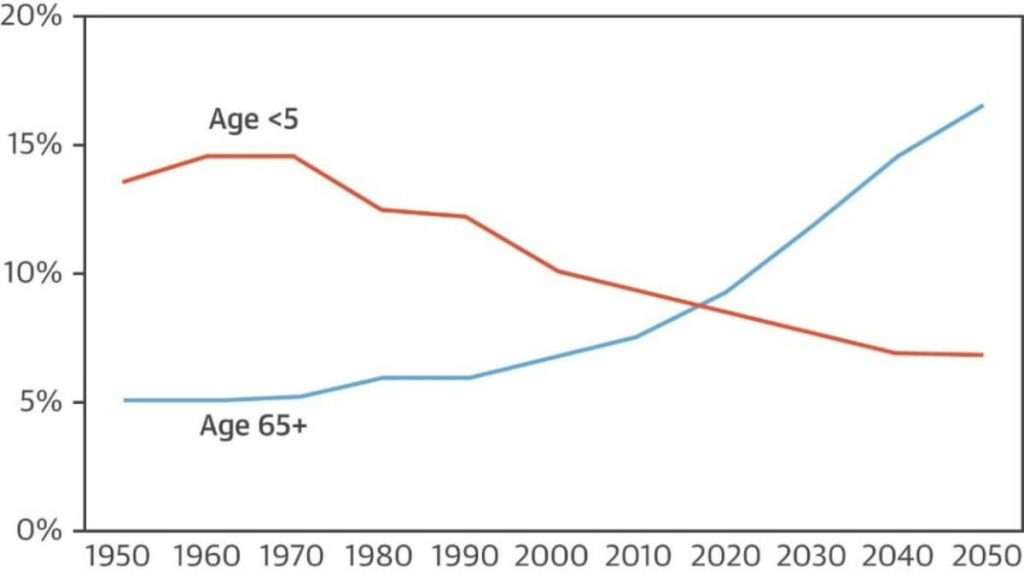
Young Children and Older People as a Percentage of Global: 1950 to 2050
Salari et al (2022) conducted a systematic review on the global prevalence of falls, including over 100 studies and a sample size of 1.7 million older adult patients, estimated the global prevalence of falling to be 26.5%–with the highest rates in Oceania (34%) and North America (27.9%). Fall risk is a serious concern in older individuals, and can result in bone fractures, head injuries, and possible hospitalization.
Causes of falls are multi-faceted and may involve age-related declines in vision, balance, muscle mass, and muscle strength. Vision is essential in processing environmental information and adjusting our bodies in space. Balance is also impacted by our somatosensory and vestibular systems. Somatosensory refers to how our neuromuscular physiology responds to touch and changes in movement. The vestibular system is mainly neurological and regulates our orientation based on sensory organs within the ear canal. Muscle mass and muscular strength enable us to support our bodies through various positions and movements.
The FRA System
In assessing fall risk, it may be important to keep these factors in mind from a prevention standpoint. The InBody Fall Risk Assessment (FRA) System is a newly developed technology that has been shown to measure variables that are associated with balance and muscular functioning. Dr. Woo-Chul Park et al (2022) at the Kyung Hee University Medical Center in Seoul, Korea conducted a study on 289 community-dwelling adults over the age of 65. Using the InBody FRA System, they found that it was significantly correlated with validated measures of assessing fall risk.

Three components of the Fall Risk Assessment (FRA) system: balance measuring instrument, InBody body composition analyzer, and leg muscle dynamometer.
The FRA System consists of three components: the balance measuring instrument, body composition analyzer, and leg muscle dynamometer. The balance measuring instrument assesses how well a participant’s vision, somatosensory, and vestibular systems maintain balance. Skeletal muscle mass, especially in the lower body, is determined with the body composition analyzer. The leg muscle dynamometer tests leg muscular strength.
The FRA system also features a training mode that enables users to play fun and interactive games that are tailored to their test results. The training mode can serve as an engaging way to strengthen one’s balance ability based on feedback.
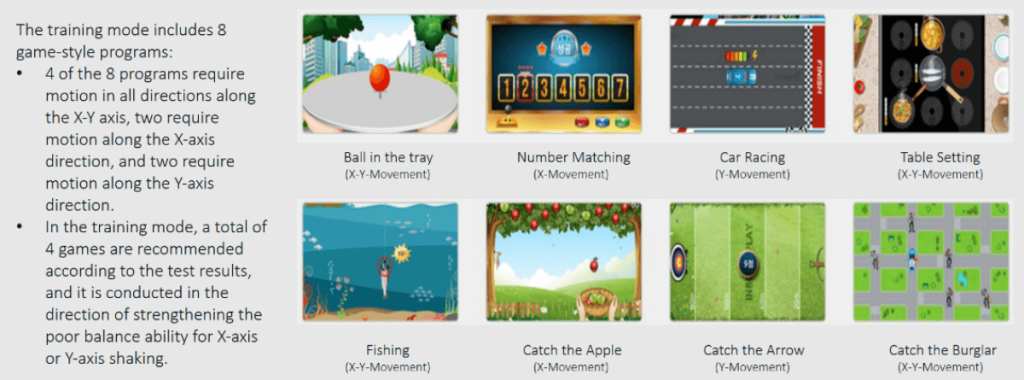
The Fall Risk Assessment (FRA) Systems Training Mode:
The multi-systematic technology of the InBody FRA system can be a helpful tool for future clinical and health-oriented considerations for assessing factors related to fall risk in older adult populations.
For more on fall risk, health, and other applications, subscribe to our newsletter and connect with our medical & research team today.
References
- World Health Organization. (2021, April 26). Falls. World Health Organization. https://www.who.int/news-room/fact-sheets/detail/falls https://www.who.int/news-room/fact-sheets/detail/falls
- Kyriazis, M. (2020). Ageing throughout history: the evolution of human lifespan. Journal of molecular evolution, 88(1), 57-65. https://doi.org/10.1007/s00239-019-09896-2
- United Nations. (2022). Ageing. United Nations.
- World Health Organization. (n.d.). Ageing. World Health Organization. https://www.who.int/health-topics/ageing#tab=tab_1
- Fuster, V. Changing Demographics: A New Approach to Global Health Care Due to the Aging Population. JACC. 2017 Jun, 69 (24) 3002–3005. https://doi.org/10.1016/j.jacc.2017.05.013
- Salari, N., Darvishi, N., Ahmadipanah, M., Shohaimi, S., & Mohammadi, M. (2022). Global prevalence of falls in the older adults: a comprehensive systematic review and meta-analysis. Journal of orthopaedic surgery and research, 17(1), 334. https://doi.org/10.1186/s13018-022-03222-1
- Vaishya, R., & Vaish, A. (2020). Falls in older adults are serious. Indian journal of orthopaedics, 54, 69-74. https://doi.org/10.1007/s43465-019-00037-x
- Saftari, L.N., Kwon, OS. Ageing vision and falls: a review. J Physiol Anthropol 37, 11 (2018). https://doi.org/10.1186/s40101-018-0170-1
- Toledo, D. R., & Barela, J. A. (2010). Sensory and motor differences between young and older adults: somatosensory contribution to postural control. Brazilian Journal of Physical Therapy, 14, 267-275. https://doi.org/10.1590/S1413-35552010000300004
- Fawzan, S., Kozou, H., Baki, F. et al. Fall risk assessment and effect of vestibular rehabilitation in the elderly population. Egypt J Otolaryngol 38, 88 (2022). https://doi.org/10.1186/s43163-022-00277-z
- Gadelha, A. B., Neri, S. G. R., Oliveira, R. J. de, Bottaro, M., David, A. C. de, Vainshelboim, B., & Lima, R. M. (2018). Severity of sarcopenia is associated with postural balance and risk of falls in community-dwelling older women. Experimental Aging Research, 44(3), 258–269. https://doi.org/10.1080/0361073X.2018.1449591
- Pizzigalli, Luisa. Filippini, Alberto. Ahmaidi, Said. Jullien, Hugues. Rainoldi, Alberto. (2011) Prevention of Falling Risk in Elderly People: The Relevance of Muscular Strength and Symmetry of Lower Limbs in Postural Stability. Journal of Strength and Conditioning Research 25(2): p 567-574, https://doi.org/10.1519/JSC.0b013e3181d32213
- Park, W. C., Kim, M., Kim, S., Yoo, J., Kim, B. S., Chon, J., … & Won, C. W. (2019). Introduction of Fall Risk Assessment (FRA) system and cross-sectional validation among community-dwelling older adults. Annals of rehabilitation medicine, 43(1), 87-95. https://doi.org/10.5535/arm.2019.43.1.87


